Showing posts with label Japan USMEF Mission 2013. Show all posts
Showing posts with label Japan USMEF Mission 2013. Show all posts
January 2, 2014

July 14, 2013
Wagyu on the Hoof—and Tons of Tongue!
 |
| Wagyu beef cattle partake of rice straw at the feeding facility in Ishinomaki City. |
SENDAI REGION (Saturday, July 13, 2013)— Packed our bags and
left the Westin Hotel, headed to Ishinomaki City, about 40 minutes away.
On the way, we passed an area hard hit by the tsunami. In this case, a major highway actually
served to protect one area, while the area on the other side closest to the
coast was virtually wiped out.
All of us have been astonished at the rapid rate of rebuilding—homes,
businesses and infrastructure.
We arrive at Ushichan Farm, a Wagyu beef feeding facility
with 600 head of high-end, black-hided Wagyu cattle. This facility purchases 600 lb. feeder calves at
auctions for about $5,000 per head and feeds them out over a two year period.
The cattle are fed about 20 pounds per day on imported
grains and rice straw, purchased from local farmers—typically on a barter basis
in return for the manure. In fact, the feeding facility is virtually
surrounded by rice fields. This company owns three feeding facilities with a
total of 2500 head.
These animals can command up to $15,000 per head at finish,
with an average of $9,000 to $10,000. Feeding costs are about $2,500—and death loss is about one
percent.
 |
| Buck Wehrbein (left) and Patrick Knobbe (right) pose with one of the managers of the Wagyu feeding facility. |
We were not allowed to walk through the sheltered barns
since our presence would disturb the animals.
The feeding system is a blend of automation and
hand-feeding. Feed is delivered to
the feed alley through automation, but is hand-fed to the animals by
employees. When cattle are
fat and ready for market, they are led by rope to the truck.
The majority of the cattle at this facility are sold to
Starzen International, a representative of which accompanied us on the tour.
Tons of Tongue
We return to Sendai City for our last meal in Japan—lunch at
Kisuke, a restaurant which features 30 different menu items—all using beef
tongue (much of it from the U.S.)
We had tongue gravy on tofu, tongue sausage, ground tongue, grilled
tongue, tongue salad—it was reminiscent of the scene in "Forrest
Gump" in which Bubba lists the various ways to prepare shrimp!
 |
| Ohgawara-san, chairman of the Sendai Beef Tongue Association and owner of the Kisuke beef tongue restaurant chain. |
The chain has 25 restaurants, serving 1,000 tongues per day
in total. Ohgawara-san, chairman
of the Sendai Beef Association and owner of the Kisuke chain, joined us for
lunch.
We are also joined by Kioshi Nagao and Miss Naomi Edo from
Soma Relief 311, another non-profit organization formed to help disaster
victims. This organization has
focused on the area of Japan affected by the disaster trifecta—earthquake,
tsunami and nuclear meltdown—with a special emphasis on assisting youth who
lost one or both parents, family members and/or friends. Leiko Shimane from USMEF has worked closely with
this group.
In the two-plus years since the disaster, Soma Relief 311
has provided summer camps for these young people including a wide variety of
outdoor activities such as camping and hiking. USMEF has provided U.S. beef and pork to feed the
campers—and continues to do so.
This will be the last year of the summer camps,
as the
organization is now looking to establish
 |
| Leiko Shimane of USMEF and Kioshi Nagao of Soma Relief 311 share a toast at lunch. |
The first such program is taking place through Portugal—and there was discussion at lunch about working together to establish a program with Nebraska to bring young Japanese to Nebraska farms and ranches for an exchange experience.
After lunch, we have about 30 minutes to shop at a Sendai
department store before heading to the Sendai airport for a short flight to
Tokyo—and a looong flight home to the U.S.
Sayonara, Nippon!
Making People Well: Hip-Hop Heroes on Katsura Island
 |
| Masahido "Masa" Oodo, the head of Bond and Justice, mugs for the camera as he grills U.S. beef for our team and the residents of Katsura Island. |
KASTURA ISLAND, JAPAN (Friday, July 12, 2013)—In the Japanese language, the phrase "to eat" is written using Chinese characters that literally mean "making people well"—and we saw the power of that phrase at work during a Friday afternoon visit that will become one of most memorable moments of this mission.
On March 11, 2013, the residents of Katsura Island had about
one hour's notice that the tsunami was headed their way. None of them chose to leave. The
younger folks on the island gathered the elderly and got everyone to the
highest-most point on the island—an elementary school. From this vantage point, the villagers
watched as the tsunami destroyed much of the island and wreaked havoc on the
small boats, oyster beds and seaweed beds on which they relied for their
livelihood.
Inside this bay, which is dotted with islands, the tsunami
wave was not the 90-foot wave that hit the coast directly, but was no less
devastating as water came in from every direction and brought waves 15 to 20
feet high that wiped out much of the housing on the island and damaged the
piers and boats.
 |
| Residents of Katsura Island enjoy the meal served during our visit. |
Since the disaster, the younger people who used to live on
the island have left—leaving only about 100 people, with the youngest being
around 50 years of age. Many
of this elderly population are living in temporary housing and just recently
have been able to resume their seaweed and oyster operations.
Why did our mission visit this island? Because the Nebraska Corn Board and
Nebraska Beef Council were the first U.S. organizations to be in Japan with
support for the islanders and to other Japanese victims of the tsunami. Working
with USMEF, these two Nebraska-based organizations helped provide beef and pork
and other foodstuffs to the remaining islanders. USMEF partnered with a number of Japanese organizations to
make that happen, including Hannan, the food processing company we visited
earlier on Friday.
On Katsura Island
We traveled north from Sendai to Shiogama, from which we
took a boat out to Katsura Island where were were greeted at the pier by a
ragtag bunch of young men with small pickups who took us to the top of the
island. It turns out that this
group of fun-loving guys is making a huge difference to the people of Katsura
Island.
When the disaster hit the island, Masahiro "Masa"
Oodo, a well-known Japanese hip-hop record label executive, decided something
needed to be done. So he reached
out to his music industry pals across Japan to join him in a relief effort for
this island—and they came from near and far. (Even American rapper Snoop Dogg provided financial
support.)
 |
| Residents of Katsura Island enjoyed the meal and having visitors from Bond & Justice and Nebraska. |
Masa wears a tattoo on each arm. On his right arm is artwork with the word "bond",
denoting that his handshake is his word and bond. His left arm bears a tattoo with the word
"justice"—placed there since that is the arm closest to his heart. When the quickly-organized group of
musicians was formed, they were looking for a name—and "Bond and Justice" was a logical and meaningful choice.
USMEF partnered with Bond and Justice to bring in meals to
the island residents. Leiko
Shimane from USMEF was integrally involved in this effort, helping coordinate
support from a number of partners.
The Bond and Justice posse visits the island about twice
per month, coming from all across Japan to help continue the clean up, prepare
meals and provide the social interaction and connection with the world that the
remaining residents crave and need.
And it is clear that this bunch of mostly 30-somethings enjoys being
around each other—and the islanders enjoy having them around.
 |
| A member of Bond & Justice proudly displays his Nebraska Cattlemen lapel pin—in a unique way! |
Setting up shop on the steps of the elementary school during
our visit, this crew grilled U.S. beef, prepared salads and vegetables and
poured libations. It was a festive
and fraternal atmosphere—and even though the residents and most of the Bond
and Justice team did not speak English, there was plenty of
"conversation" and camaraderie among all.
It amazed all of us how quickly we connected with the selfless young musicians and the courageous people who live on the island–and there were teary eyes and lumps in throats as we boarded our boat back to the mainland. Clearly, we had all had a very powerful and personal experience—and were touched at the dedication and selflessness of a group of young hip-hop musicians.
 |
| The Nebraska beef and corn team on Katsura Island with members of Bond and Justice and several residents of the island. |
We only spent about three hours on the island with the Bond
and Justice team and the villagers they are serving—but the memory and the
connection with this place and the people will last a lifetime.
Making people well—in both their stomachs and their souls. That's what Bond and Justice is
doing, thanks in part to USMEF and the generosity of Nebraska corn and beef
producers.
July 13, 2013
Off to Sendai by Bullet Train
 |
| A Wagyu beef carcass is auctioned off at the Sendai meat market. We saw one carcass command a $12,000 price. |
SENDAI REGION, JAPAN (Friday, July 12, 2013)—Up very early to catch the bullet train north to Sendai, about 180 miles from Tokyo. Some interesting countryside to see—rice fields, mountains, rural areas—as we sped along at some 160 mph!
First stop this morning was a packing plant that was damaged
in the earthquake in 2011. During
that year, their slaughter rate dropped by 50% due to structural damage,
followed by the radiation scare a few weeks later.
 |
| Workers at Hannan prepare short plate strips for ready-to-cook meals. |
We had a rare opportunity to be invited into a Wagyu beef
processing facility. Consider that
those of us promoting American beef are actually their competitors, so this was
quite a coup to be shown around the plant. (Thank you, Yama!)
This plant processes a high volume of Wagyu beef, and we
were privileged to witness that morning's auction of Wagyu carcasses—fetching
as much as $12,000 US for a 950 lb carcass! The plant processes 23,000 head per year—not all of it
Wagyu.
The Sendai region is known for its Wagyu beef and has
established a brand called Sendai Beef. They say the secret is the "Miyagi
nature"—the cool, clear water of the region, coupled with feeding straw
leads to the highly marbled meat.
Wagyu beef is graded on a scale from A1 to A5—with A5 being
the highest quality.
After the Japanese BSE incident in 2001, the Japanese government
required that all cattle—100%—be tested for BSE. That changed this month, as the testing is now
required only for cattle 48 months or older. Since most Wagyu beef is 30 month, this has eliminated the
need for BSE testing for this product.
 |
| Hundreds of beef tongues thaw at the Hannan food processing plant. |
The next stop was Hannan, a food processing company, where
our host greeted us wearing a "Nebraska" shirt and socks with stars
and stripes. A real card, this
guy!
Hannan specializes in a wide variety of food products. We saw them cutting short plate into
strips and packaging the beef along with vegetable and sauce for a ready-made
meal. Hannan was a partner
with USMEF in providing the bento box meals to the disaster victims in 2011.
They are also huge purveyors of beef tongue, processing
3,000 tongues per day. That's
right—per day!
We headed toward the coast, where we saw some of the damage
and rebuilding that has occurred since the earthquake and tsunami in 2011. Trees are leaning every which way
from the force of the water—and their branches are stripped some forty to fifty
feet up from the ground. Much
rebuilding going on, but you can still see considerable damage.
 |
| Yama (left) and John Hinners from USMEF talk with Mr. Eiichi Nakayma, managing director of the Higashiyama Korean barbecue restaurant chain. |
Friday night we had Korean barbecue at Higashiyama restaurant,
one of a 40+ chain that has worked closely with USMEF to offer their customers
U.S. beef and pork. Mr. Eiichi
Nakayama, managing director for the company, joined us for dinner. The company has been
incorporating more U.S. beef into their dishes.
You may note that there is no information about what we did
Friday afternoon. That experience
merits a blog post all its own—and will be coming soon.
July 12, 2013
Catering to a Roomful of Customers
 |
| Some 640 meat buyers enjoy samples of U.S. beef and pork during the USMEF seminar and tasting session |
TOKYO, JAPAN (Thursday, July 11, 2013)—This
afternoon/evening, USMEF hosted some 640 key Japanese meat buyers at a U.S.
Meat Seminar & Tasting Session held at Hotel Okasa.
USMEF President & CEO Phil Seng welcomed the group, as
did David Miller from the U.S. Embassy.
Both pointed out the change to the availability of 30-month US beef and
thanked those in the room for their support of U.S. beef and pork.
Dr. Ron Plain,
University of Missouri, brought the group up to date on the state of key ag
production figures:
CORN OUTLOOK:
Forecast for this year: 14
billion bushels—a record by one billion.
If it happens, it would ould lead to lower corn price, lower feed costs,
lower meat production costs.
USDA forecasts a $2 drop in corn prices, the biggest year-to-year drop
in history.
BEEF OUTLOOK:
Beef production grew rapidly in 50s and 60s. Peaked in 1975, but not a lot of growth since then. The number of cattle in the U.S.
continues to decline...we know have the smallest cattle herd in U.S. since
1952. So how are we producing more
beef with fewer cattle? Producers
are getting better at what they do.
Improved Calf health. Less
death less. Slaughter weights
up. It all helps increase the
amount of meat from a smaller cattle herd.
Over the past two years, there has been a relatively high
percentage of slaughter of herd (mother cows). If that percentage drops, more mothers, more calves.
If we get better weather (i.e. rain), we'll have better
pasture. This should lead to a sharp
drop in slaughter of mother cows.
While there will be a short term drop in supply, there should eventually
be more cows which leads to more calves which leads to more beef on the
market—and that should put downward pressure on price.
 |
| Meat buyers and purveyors listen intently to presentations on marketing, promotion, quality and availability of U.S. beef and pork. |
PORK OUTLOOK: Pork
has been the most stable meat in the U.S.
Essentially a 1.5% annual growth since 1930. More dependent on exports. Hog farmers are getting better at what they do, more pigs
per sow per year. More than
doubled production per sow since 1930.
Better production in beef and pork makes price increases
less than cost of living increases—making both products a good value.
MAJOR UNCERTAINTIES:
Cost of feed and weather.
Economic growth. Growth in
breeding herds if feed supplies increase.
Exchange rates. But the yen
is getting weaker, which should make U.S. products more attractive to Japan.
REIKO OGATO of Dentsu,
Inc. , Japan's largest advertising agency, spoke about branding. The volume of information available to
consumers has exploded. What was the
information contained on one sheet of paper in 1996 will become 100,000 pages
(the height of a six-story building) by 2025.
It used to be that information to consumers was driven by
manufacturers. But with social
media, the consumer has become a significant driver as they search for
information and then share what they have learned through experience. That cycle repeats over and over—and
the manufacturer has less influence as a result. "The consumer cannot be controlled by the message
sender," she said.
 |
| Taz from the USMEF Japan office presents information on the "juku" campaign to promote the increased availability of U.S. beef. |
This "differentiation" message was echoed by
Susumu "Sam" Harada from USMEF, as he spoke about the opportunity to
set American beef and pork apart in the marketplace.
USMEF's Takemichi
"Yama" Yamashoji and
presented information on American beef and pork, pointing out the
aggressive consumer information and chef training programs that USMEF is
implementing. Home runs such
as the Dean & Deluca decision to use American beef and the promotion of
"chunk" beef and pork for family dining were presented—as well as a
number of cooperative promotional opportunities which those in the room could
take advantage of. The underlying
message was that USMEF is here to help these buyers succeed in reaching their
customer and in reaching consumers.
A couple of interesting notes:
- Outdoor barbecuing (grilling) is on the rise in Japan, to some degree because camping out is becoming more popular.
- July 22 is a date on which most Japanese prepare grilled eel for dinner, as it is believed that eel helps increase one's stamina in the hot summer weather. But eel prices are high, so USMEF is promoting the use of soy sauce-sauteed American pork as a substitute—that can also provide the energy and stamina Japanese people need to withstand the oppressive weather this time of year.
 |
| Mark Jagels of Davenport, Nebraska Corn Board director and Chair-Elect of USMEF, addresses the crowd of 640 meat purchasers prior to the beef and pork tasting session. |
Following the seminar, the 640 attendees were treated to a
tremendous spread of American pork and beef prepared in a variety of ways. USMEF Chair-Elect Mark Jagels
welcomed the group and thanked them for their support of American beef and
pork—and assured them that American producers would continue to provide safe,
wholesome and delicious products.
Our team remarked on the incredible impact USMEF activities
had in just over 24 hours—from reaching 40 influential food bloggers the
previous day to educating 640 key meat buyers (at every market level) at a
trade and tasting seminar. A
pretty impressive couple of events, to be sure.
July 11, 2013
Busy Ports & Cold Storage
 |
| Members of the Nebraska beef team proudly display beef from Nebraska Beef from the Nippon Ham cold storage facility. |
TOKYO, JAPAN (Thursday, July 11)—We went a bit further up
the "food chain" this morning to see where American beef comes into
Japan—and where it goes into storage before heading out into the marketplace.
The entire USMEF mission group–including both the beef team
and the pork team—boarded a bus for a 30-minute trip to the Yokohama port on
the Tokyo Bay, into which a large volume of beef and pork
 |
| The APL facility at Yokohama port. |
It takes about two to three days for American beef to move from the Midwest to the West Coast ports—and about two weeks to travel on ship before arriving in Yokohama.
APL prides itself on its technology, which includes sophisticated
atmosphere control and monitoring inside refrigerated containers (reefers) to
ensure product integrity and quality.
 |
| Omaha-based Nebraska Beef is a company/brand owned by Nippon Ham. |
Then we visited the largest cold storage facility in Japan,
owned by Nippon Ham, which is the largest importer of beef in the nation. (Ito
Ham is second.)
Decked out in hardhats and parkas (hard to complain about
the sub-zero cold when we've been dealing with 95-degree temperatures and
stifling humidity!), we took a tour of this huge facility and saw beef from not
only the U.S. and Australia, but also New Zealand, Chile, Mexico and other
nations.
We saw a number of products produced in Nebraska
specifically (Lexington, Dakota City, etc.) Interestingly, Nippon Ham owns a company (and a retail
brand) called Nebraska Beef, which is headquartered in Omaha.
The major takeaway from today's tours was a better
understanding of the sheer volume of meat products coming into Japan—and the infrastructure
in place to handle increased supply of both beef and pork from the U.S.
July 10, 2013
A Visit with High-End Retailers—and a Taste of Wagyu Beef
TOKYO, JAPAN (Tuesdauy, July 9)—We met with representatives
of Ito Ham in the USMEF offices this afternoon. With almost $4 billion in sales last year, Ito Ham is the second
largest Wagyu beef company and the second largest ham and sausage provider in
Japan. Ito Ham is one of the largest
 |
| Members of the beef mission meet with officials from Ito Ham in the USMEF offices in Tokyo. |
U.S. beef suppliers are JBS (Texas and Pennsylvania),
National Beef in Dodge City, Tyson in Lexington, Nebraska, and PM Beef in
Minnesota. They have a
relationship with two plants in Australia, from which they source their Angus
beef. They own a feedlot and plant
in New Zealand.
As a company, 60% of their imported beef is from Australia,
30% U.S. and 10% New Zealand.
Ito Ham expressed concern about shelf life and color with
U.S. beef. Aussie beef has a
75-day shelf life, while U.S. is just 60 days. Ito Ham is asking why there is a difference. The USMEF team and the producers pledged to work in partnership with Ito Ham determine what research as been done on this issue and arrive at solutions and answers that satisfy our important Japanese customers.
 |
| A chef at the Ito Ham store in the Shinjuku area prepared Wagyu beef for our team to sample. |
Later in the afternoon, we visited Ito Ham's boutique beef
store in the trendy Shinjuku district of Tokyo, where we were treated to a
sample of melt-in-your-mouth Wagyu beef—including some with fois gras, butter and wine. "Wow!" was the reaction of
most of the team. (One man's opinion: The first bite is pretty special. But the next one, not so much; as the
richness and high fat content starts to get very heavy very quickly.)
Some meat in the counter was north of $180/lb.
The second store chain we met with was Tokyu, which caters
to a higher end consumer. With 90
outlets, Tokyu began selling U.S. beef in February 2012, and sales have been
rising, especially beef tongue.
Tokyu also has convenience stores, shopping center, and a
super-high-end store called Precce.
Precce is practically across the street from the Tokyu store we visited,
but the prices and selection were vastly different. Example: Pressa
was selling tomatoes for $2 each, peaches for $5 and watermelons for $58. A cut of Wagyu beef of 2.5 kilos
(about five pounds) was priced at $85.
The exchange rate is making it difficult for these stores to
justify increasing their use of American beef.
Over the past two days, we have seen a wide range of retail
outlets for American beef—and all of the companies are pleased that American
beef is now more available in their market. It's important, however, that the product fit within their
business model and is matched to their consumers' taste.
The fact that American producers are here meeting with them
face to face, however, is greatly appreciated and is having a very positive
effect. We also have heard
appreciation and kudos from all the companies regarding their relationship with
USMEF and the support and service this organization provides.
 |
| Mark Jagels and Dale Spencer inspect American beef available at the Tokyu store. |
The general takeaway is that these Japanese buyers and retailers are sharp—and they know what they want. At the same time, we need to educate them. Just as there has been almost a generation of Japanese consumers who have not been exposed to the value and benefits of American beef, there is almost a generation of buyers as well.
Most, if not all, of the retailers and purveyors we met with were in their late 20s or early 30s—and were teenagers or young adults when American beef disappeared from the Japanese market ten years ago. They need to be brought up to speed and quickly.
Food Blogger Event a Grand Slam Home Run for U.S. Beef and Pork
 |
| Food bloggers rushed the stage, cameras in hand, to take photos of dishes featuring U.S. pork and beef. Food TV star Rika Yukimasa shows off the dish. |
TOKYO, JAPAN (Wednesday, July 9)—A tremendous
USMEF-sponsored event today. Some
40 food bloggers from across Japan met with the full American beef and pork
teams for lunch. Phil Seng,
president and CEO of USMEF, said the bloggers represented the "fresh voice
of the consumer"—and it was important that they learn about the value of
American pork and beef and how to help Japanese consumers learn how to enjoy it
to the fullest.
 |
| Japanese TV star Rika Yukimasa shares tips on preparing American beef & pork with Japanese food bloggers. |
Rika Yukimasa, a charismatic up and coming
"foodie" television star and mother of two, gave a fabulous presentation
on preparing American beef and pork.
Her English was impeccable thanks to five years in the U.S. attending
Cal Berkeley. She switched easily
between two languages as she extolled the virtues of U.S. beef and pork—and
showed how to properly season and cook these premier American products.
She noted that Japanese tend to slice meat very thin and
then cook it. American beef and
pork require a different preparation method to take full advantage of the
robust flavor and tenderness—so she showed the foodies in the audience how to
best prepare these products, with an emphasis on slow cooking and thin-slicing
the product after it is cooked, rather than before, which is the traditional
Japanese method.
As each prepared final dish came out of the oven, the
bloggers (primarily female) rushed the stage with cameras to take dozens of
photos. It was a frenzy repeated
each time a new dish was finished.
Samples of all dishes were served as lunch to all in
attendance—and the American producers in the audience took the opportunity to
share photos of their family farms and converse as well as they could about the
quality of American red meat. It
was a great and rare opportunity for influential Japanese social media leaders
to put a face on American beef and pork.
 |
| Nebraska Corn Board member Tim Scheer (left) talks with food bloggers during today's lunch event. |
USMEF will monitor the Japanese foodie blogosphere following
today's home run event. The bottom line is that dozens of food writers went home satisfied and better informed about American beef and pork.
July 9, 2013
Major Beef Packers & A Major Ad Campaign
 |
| The Nebraska Corn Board-sponsored team stands in front of one of the USMEF ads promoting U.S. beef in Tokyo Station. From left to right: Tim Scheer, Dale Spencer, Doug Parde, Kyle Cantrell and Mark Jagels. |
TOKYO, JAPAN (Wednesday, July 10)—This morning opened with a
breakfast meeting with key Japanese packers including ISO, Cargill, Tyson and
National. The entire USMEF
mission team—representing corn, soybeans, beef and pork from nine states—had
informal discussions with these representatives.
 |
| USMEF President and CEO Phil Seng thanks the packers for joining us for breakfast. |
USMEF CEO Phil Seng opened the meeting by thanking the
packers for joining us, noting that "These folks are the pathfinders and
we thank them for being with us, even when the going got tough."
The Cargill representative noted that while China gets a lot
of attention, "don't forget Japan; we're back after 10 years."
During the conversation with the Tyson rep, he noted that
there is a focus on the top hotels
across Japan—working hard to get them to reintroduce American beef to
their menus, especially for the large and lucrative catering business. Essentially, they focus on the premium
hotels, considering them as "bell cows" which other hotels will
follow.
He also said that, now that American beef is back in the
Japanese marketplace, the next stage will be brand differentiation, perhaps
including store-level private brands of American beef.
 |
| Kyle Cantrell listens to a Japanese packer representative. |
Following breakfast, we took a quick trip to Tokyo Station,
one of the largest public transportation hubs in Tokyo, through which some
400,000 people pass each day.
USMEF has place a high-profile saturation advertising campaign in the
main pedestrian throughway, with repeated ads for American beef. Several dozen ads appear on columns
throughout the area—promoting the "juku" campaign and soliciting
entries in the sweepstakes noted in an earlier blog.
Next up:
One-on-one conversations with several dozen of Japan's leading food
bloggers.
Japan Optimistic, But Faces Challenges
TOKYO, JAPAN (Tuesday, July 9)—A visit to the U.S. Embassy in Tokyo today, which included a brief appearance by Ambassador Roos. (Photo equipment not allowed inside the Embassy, so you'll have to imagine!)
Some interesting tidbits from the various presentations we heard:
Upcoming Election Could Lead to New Initiatives
There is an election July 21 for the Upper House of Japan's two-house Diet (their legislative body). Japan is a parliamentary democracy. The Lower House, which is in the hands of the ruling party, is the most powerful of the two; but the Upper House, which has been in the hands of the opposition party, has stifled the leadership's economic, fiscal and growth initiatives. There is every indication, however, that the ruling party will gain control of the Upper House, thus enabling proposed legislation to become a virtual slam dunk through both houses of the Diet.
Japan has suffered through two decades of economic doldrums and has been a bit forgotten as it has fallen in the shadow of China's growth. Still, Japan is the third largest economy in the world. Japan has $47,000 per person GDP, compared to $6,000 per person GDP in China; so the purchasing power in Japan is enormous—and they are used to spending dollars to get what they want.
The March 2011 Earthquake & Tsunami
The March 11, 2011 tsunami caused over $30 billion in damage and took more than 64,000 acres of agricultural land out of production. Some 315,000 refugees remain—and about 38% of the farmland has been restored. Cost for reconstruction in FY2013 alone is $44.7 billion.
Japan was just crawling out of its economic hole when the earthquake and tsunami hit in 2011. One significant outcome of the disaster: Prior to the incident, 30% of Japan's energy was generated through nuclear power; since the disaster, that has fallen to less than 1 %—so Japan finds itself paying big yen to import oil and natural gas.
Additionally, the public debt in Japan is 235% of GDP, the highest in the world. There has been a slow but steady population decline. Japanese women have 1.4 children on average. By 2050, more than 38% of the population will be over age 65.
Food Security
Food self-sufficiency is a huge concern in Japan—and several recent food threats, including the nuclear disaster, have done nothing to quell those fears. Japan is the #1 customer for U.S. corn, pork, feeds, frozen vegetables, and fresh citrus. As noted in an early post, they will also soon regain their position as the #1 customer for U.S. beef.
As U.S. beef exports to Japan rise back to previous levels and beyond, we will need to keep an eye on the "safeguards" Japan has in place. If imports reach theses safeguard levels, tariffs increase significantly.
However, these safeguard levels are programmed to rise steadily over time.
Conclusions
Some interesting tidbits from the various presentations we heard:
Upcoming Election Could Lead to New Initiatives
There is an election July 21 for the Upper House of Japan's two-house Diet (their legislative body). Japan is a parliamentary democracy. The Lower House, which is in the hands of the ruling party, is the most powerful of the two; but the Upper House, which has been in the hands of the opposition party, has stifled the leadership's economic, fiscal and growth initiatives. There is every indication, however, that the ruling party will gain control of the Upper House, thus enabling proposed legislation to become a virtual slam dunk through both houses of the Diet.
 |
| The Tokyo metro area has a population of more than 30 million. |
Japan has suffered through two decades of economic doldrums and has been a bit forgotten as it has fallen in the shadow of China's growth. Still, Japan is the third largest economy in the world. Japan has $47,000 per person GDP, compared to $6,000 per person GDP in China; so the purchasing power in Japan is enormous—and they are used to spending dollars to get what they want.
The March 2011 Earthquake & Tsunami
The March 11, 2011 tsunami caused over $30 billion in damage and took more than 64,000 acres of agricultural land out of production. Some 315,000 refugees remain—and about 38% of the farmland has been restored. Cost for reconstruction in FY2013 alone is $44.7 billion.
Japan was just crawling out of its economic hole when the earthquake and tsunami hit in 2011. One significant outcome of the disaster: Prior to the incident, 30% of Japan's energy was generated through nuclear power; since the disaster, that has fallen to less than 1 %—so Japan finds itself paying big yen to import oil and natural gas.
Additionally, the public debt in Japan is 235% of GDP, the highest in the world. There has been a slow but steady population decline. Japanese women have 1.4 children on average. By 2050, more than 38% of the population will be over age 65.
 |
| Japanese consumers are affluent and are willing to pay for what they want, but they are also concerned about safety and peace of mind. |
Food self-sufficiency is a huge concern in Japan—and several recent food threats, including the nuclear disaster, have done nothing to quell those fears. Japan is the #1 customer for U.S. corn, pork, feeds, frozen vegetables, and fresh citrus. As noted in an early post, they will also soon regain their position as the #1 customer for U.S. beef.
As U.S. beef exports to Japan rise back to previous levels and beyond, we will need to keep an eye on the "safeguards" Japan has in place. If imports reach theses safeguard levels, tariffs increase significantly.
However, these safeguard levels are programmed to rise steadily over time.
 |
| Mark Jagels (L) and Dale Spencer stand under a large ad for U.S. Beef placed in Shinagawa Station by USMEF. The headline says: "People who appreciate great food love U.S. beef." |
Conclusions
- Japan remains a strong market dependent for imported food.
- Japan is a relatively affluent population with diverse palates, not a stagnant market.
- Japanese consumers are willing to pay a higher price for quality and convenience.
- They are especially interested in "Anzen" and "Anshin"—safety and peace of mind.
U.S. Beef Positioned for Success in Japan
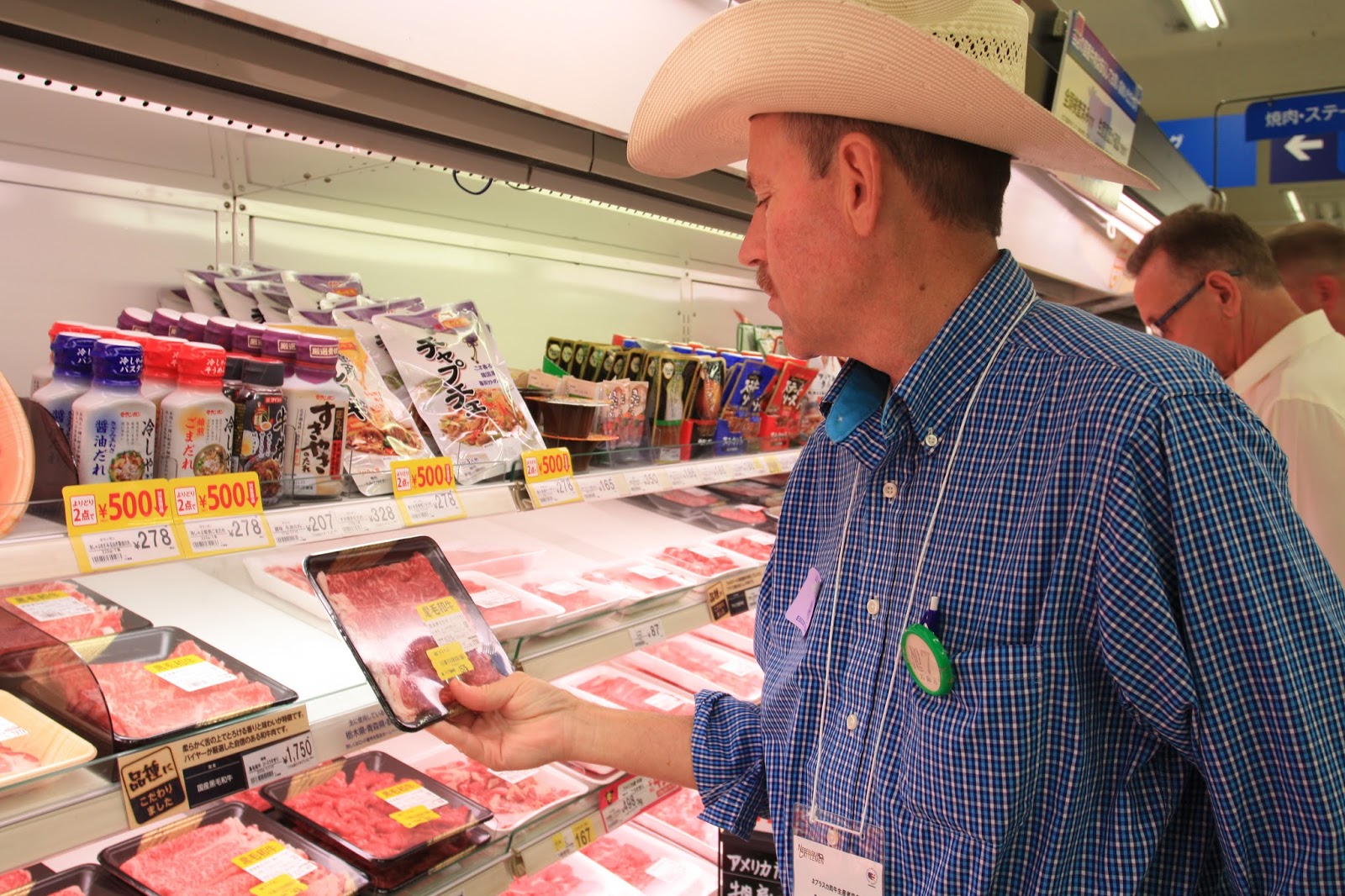 |
| Dale Spencer inspects beef on display at the Seiyu supermarket in Tokyo. |
During a one-hour discussion in the Sumikin Bussan offices today, their representatives spoke enthusiastically about U.S. beef. They also agreed with what we heard from USMEF officials: It's
 |
| "Tim" (left) and "Lucky" of Sumikin Bussan talk about their imports of U.S. beef into Japan. |
The importers were especially interested to hear from the U.S. team about projections for the U.S. corn crop—both production and price. They said they were looking for "what is true", but even our group couldn't agree on what will or might happen.
If the record corn acres and record harvests (14 billion) are to be believed, then corn prices could fall as much as $2, leading to lower feed costs and more competitive beef prices.
But then again, maybe not...
After this meeting, we visited a Seiyu store, which is Wal-Mart's brand presence in Japan. (And yes, they do wear blue vests!) We met the person responsible for buying beef not only for this store, but for all 372 Seiyu stores in Japan. (Obviously a man we want on our side...) He, too, is optimistic about the potential for U.S. beef in his stores, seeing it as a price-competitive, high-quality option for his customers.
 |
| Tim Scheer (right) talks with the beef buyer for Seiyu stores (left), while an Oregon beef producer listens in. |
Beef displays in Japan are interesting in that the portions are smaller and very consistent in terms of size. U.S. beef is being displayed at the Seiyu store we visited, some with the "We Care" sticker, which is part of the USMEF campaign.
We also saw Wagyu beef on display—highly marbled beef that is typically higher priced than U.S. product.
We observed Japanese consumers carefully perusing the beef products on display, inspecting several for appearance, quality, price, etc. Not much different than American grocery shoppers.
 |
| Japanese Wagyu beef is highly marbled. |
USMEF Aggressively Marketing U.S. Beef in Japan
TOKYO, JAPAN (Tuesday, July 9)—The day began with a briefing
from the USMEF Japan staff on the marketplace and the renewed potential of
American beef since the "less than 30 month" regulation went into
effect and dramatically increased the supply of U.S. beef to Japan.
Taz Hijikata, USMEF Consumer Affairs Senior Manager, shared
some interesting facts:
 |
| Taz Hijikata of USMEF shares insights on the Japanese consumer marketplace for beef. |
- More than 80% of Japanese consumers shop at the grocery store either every day or every other day, with 23.5% shopping every day for food.
- 50% of women have jobs outside the home.
- Japanese in Tokyo typically live in very small apartments with small kitchens, with little food storage and limited food preparation space/capability.
- Beef commands only about 10% share of the meat market in Japan. Seafood (49%) is number one, with pork (21%) and chicken (20%) taking second and third.
- Japan's per capita use of red meat is roughly one-tenth of that in the U.S., so there is plenty of upside potential.
Since the regulations allowing the import of 30 month or
less beef from the U.S. were lifted in February 2013, Japan is on track to
regain its position as the Number One importer of U.S. beef. In fact, imports are expected to exceed $1 billion in value
in 2013—up from practically zero in 2006.
In the ten years since the incidence of BSE in the U.S., there
has not been an adequate and reliable beef supply from the U.S. to Japan. Consequently, the Japanese consumer has
forgotten the delicious difference of U.S. beef. (Consider that
a 26-year-old female consumer today was a teenager when American beef virtually
disappeared from the marketplace.)
 |
| Kyle Cantrell and Doug Parde look over some of the U.S. beef promotional materials that have been developed by USMEF. |
When put to the taste test, American beef wins every time.
In November 2007, only 22.9% of consumers said they would buy U.S. beef. In March 2013, that number had risen to
65.1%.
Capturing the female consumer
is key to success of regaining the U.S. beef market in Japan. USMEF has been aggressively promoting
the increased availability through its "juku" campaign—a word that means
both "delicious" and "immediately available/ready." The USMEF campaign declares the advent for more U.S. beef as
a "wonderful moment" for the Japanese consumer.
To that end, USMEF has been
extremely successful in gaining attention for U.S. beef. Media news coverage has been very
positive, resulting in the equivalent of more than $1.5 million of
exposure. A sweepstakes
campaign, running from June through August in partnership with 1500 retail
outlets, is gaining widespread involvement—with the winners receiving American
beef products.
Dean & Deluca, a high-end
retailer, has switched from Aussie beef to U.S. beef. Several large retailers have begun to add more beef to their
meat cases. In fact, the top
three grocery stores in Japan carry U.S. beef.
USMEF is also attempting to
change the beef serving habits of Japanese consumers. Currently, Japanese families typically slice beef into very
thin strips and cook it with vegetables and other ingredients to serve. USMEF is working to get consumers to
buy larger, thicker cuts of American beef, cook those cuts in one piece, and
then slice and serve at the dinner table.
USMEF is also pointing out
that the U.S. has a grading system for its beef, unlike any other major beef
supplier to Japan. With the
new 30-month rule, they are promoting that the best of the best of U.S.
beef—and more of it—is now available to Japanese consumers.
Another important point: Japan readily takes cuts of beef that
do not sell well in the U.S.
Tongue, intestines, and other "variety meat" cuts are desired
in Japan—
and that adds considerable value to a U.S. beef carcass.
For example, beef tongue, which brings about $1.50/lb in the U.S., will garner $7 in Japan. Intestines that go for 50 cents/lb. in the U.S. will command $2 in Japan. Together, these two products alone can account for $330 million in export sales to Japan—and more cattle available will mean American beef producers can meet that demand.
and that adds considerable value to a U.S. beef carcass.
 |
| Mark Jagels, Nebraska Corn Board director and chair-elect of USMEF, addresses a group of 50 Japanese beef buyers. |
For example, beef tongue, which brings about $1.50/lb in the U.S., will garner $7 in Japan. Intestines that go for 50 cents/lb. in the U.S. will command $2 in Japan. Together, these two products alone can account for $330 million in export sales to Japan—and more cattle available will mean American beef producers can meet that demand.
The mission team also sat in
briefly at a "purveyor" information session sponsored by USMEF, which
attracted some 50 beef buyers who sell to restaurants and hotels. Attendees included Cargill, Tyson
and other major companies.
Mark Jagels of Davenport, member of the Nebraska Corn Board and
chair-elect of USMEF, made brief remarks to the group—thanking them for their
support of and confidence in U.S. beef.
The Nebraska group felt that
USMEF has a great plan to recapture the Japan market for U.S. beef—and that
USMEF is very fired up about the potential. The numbers are playing out as Japan looks to again
become the largest importer of great-tasting U.S. beef.
Subscribe to:
Posts (Atom)